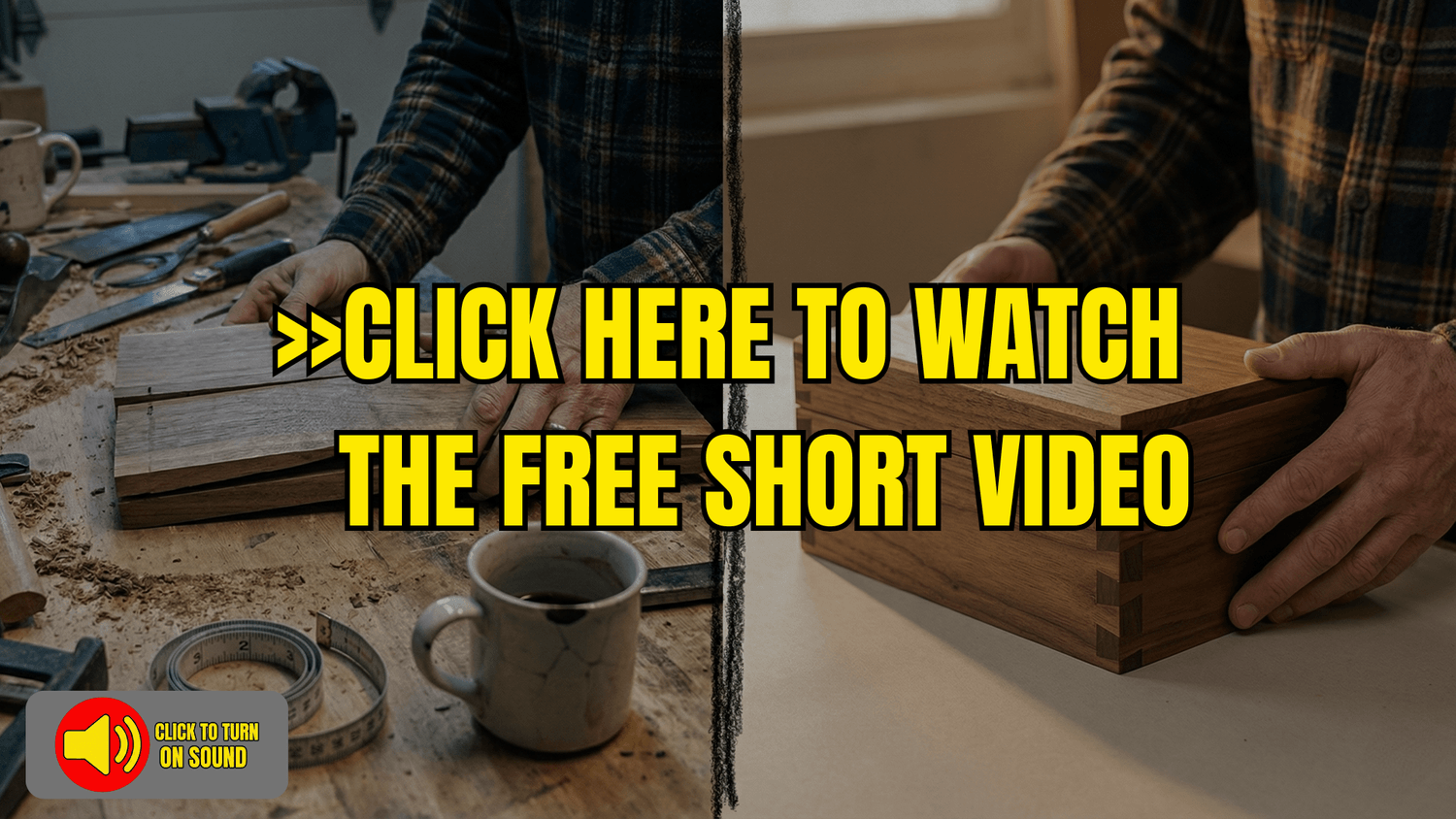
Something I can't unsee now.
That's what I said at the end of that video, and I meant it.
Because once I understood what had actually been holding me back all those years... once I saw the reason my practice never paid off the way everyone promised it would...
I couldn't go back to the old way of thinking.
Let me explain what I mean.
For three years, I did everything "right." I watched the YouTube tutorials. I bought the jigs. I practiced measuring twice, cutting once, and still somehow ended up with expensive firewood half the time.
My garage looked like a graveyard of good intentions. A jewelry box with gaps you could lose a quarter in. A cutting board that rocked like a seesaw. A table my wife politely called "rustic" when we both knew she meant "wobbly."
And the worst part?
I blamed myself. My hands. My eyes. Maybe I just wasn't built for this.
Here's what nobody tells you about the "practice makes perfect" approach:
It assumes the problem is you.
Your technique. Your patience. Your natural talent. And so you keep grinding away, making the same mistakes, buying the same tools to fix the problems the other tools created...
...while the real issue sits right there, invisible, sabotaging every project before you even pick up the saw.
I'm talking about something fundamental. Something about how we've all been approaching this backwards from the start.
Not because we're dumb. Not because we're untalented.
Because nobody showed us the other way.
The way that doesn't depend on shaky hands or 20/20 vision.
The way that removes the gambling from every single cut.
Then I stumbled onto a short presentation from someone who'd been in the exact same place.
Same frustration. Same graveyard garage. Same "what's wrong with me?" spiral.
But he'd figured something out.
Not a trick. Not a hack. Something more like a... shift.
He showed why the problem was never about practicing harder. It was about removing the one variable that turned every project into a coin flip.
Human error.
See, here's what I finally understood:
The best woodworkers in the world, the ones who make heirloom-quality furniture that sells for thousands—they don't have magic hands.
They have systems.
Systems that take the guesswork out. Systems that make precision the default, not the exception.
And for the longest time, those systems were locked behind $10,000 machines and engineering degrees.
Until someone figured out how to bring that same principle to a regular garage.
Using a simple approach I now call the Smart Saw Method.
I’m not the only one who found this "missing piece." Here is what happened when other folks followed the same presentation:
"I stopped dreading my own workshop."
— Robert M., hobbyist
"I used to avoid my garage because I knew I'd just make another mistake. Now I actually look forward to Saturdays again."
"My wife noticed before I even said anything."
— Don T., retired
"She asked me where I bought the new shelf. I told her I made it. She didn't believe me until I showed her."
"For the first time, I feel like a real craftsman."
— Gene K., weekend woodworker
"I've been tinkering for years but never felt confident in what I made. That changed completely."
Here's what I haven't told you yet.
The specific reason this works when years of practice didn't.
The simple shift that made everything click into place, not just for me, but for thousands of hobbyists who felt stuck in the exact same way.
It's all explained in a short presentation on the next page.
No fluff. No upsell before the explanation. Just a clear breakdown of:
Why the "old path" was designed to keep you struggling
What actually separates the hobbyist from the craftsman
And the simple method that bridges that gap—without needing talent, steady hands, or a second mortgage on your shop
"Once you see it, you can't unsee it."
That's not hype. It's just what happens when the pieces finally fit together.
Educational DIY guide. Results vary. Follow safety guidance and local regulations.
Copyright © 2025 EvergreenCrafting | All Rights Reserved.
This website is not part of Facebook or Meta Platforms, Inc., and is not endorsed or sponsored by them.
Facebook is a registered trademark of Meta Platforms, Inc.